EURASIAN WATER-MILFOIL
INVADES
LAKE COCHITUATE
by A.
Richard Miller (member and past Vice
Chairman
of the Cochituate State Park Advisory Committee).
This
personal Web page does not
necessarily represent the
views,
opinions
or recommendations of
the CSPAC or DCR.
visits since
020729; last updated 091124.
Updates
(immediately below)
Main article (from 2002)
Resources (links)
The Natick Conservation Commission's pre-existing Order of Conditions
(issued
May 2nd, 2006) denying
Mass. DCR's NOI for the Control of Nuisance Aquatic Vegetation with
Herbicides in Lake Cochituate.
 November 17th, 2009: POWR files its Memorandum of Law In Support Of Order Prohibiting Use of Chemical Herbicide in Lake Cochituate (including testimony by D'Amore, Horowitz, Lyman, Monosson, and Strauss).
Saturday, August 22nd, 2009: The NY Times questions another weed killer in our drinking water:
"Debating How Much Weed Killer Is Safe In Your Water Glass" (NY Times)
August 19th, 2009: POWR appeals the Mass. DEP decision.
August 18th, 2009: Natick Conservation Commission appeals the Mass. DEP decision.
August
5th, 2009: Mass. DEP's Superseding Order Of Conditions invalidates NCC's
Middle Pond OOC (no DASH-boat, weakened measurement program).
June ?, 2009: Mass. DCR appeals the NCC OOC to Mass. DEP.
April 23rd, 2009: The
Natick Conservation Commission issues its Order of Conditions for
herbicide treatment at the north end of Lake Cochituate's Middle Pond (see below).
|
Public Meeting Announcement
7:30 PM Thursday, June 4th, 2009
Selectmen's Meeting
Room (2nd Floor front), Natick Town Hall
Application
For Use of Aquatic Pesticides in North Pond of Lake Cochituate
Public hearing
before the Natick
Conservation Commission
How to manage the
growth of Eurasian water milfoil and other invasive aquatic weeds in Lake
Cochituate's
Middle Pond? Trust the chemical proponents, heed the environmental
warnings, or follow the Precautionary
Principle? After years of
disagreement, Framingham, Natick, Wayland
and Mass. DCR agreed on a one-time spot treatment of chemicals in North
Pond,
followed by a non-chemical approach - and on a NO-chemicals approach in
Middle Pond, whose water Natick drinks.
However, on January 30th, 2009 we learned that, instead
of partnering, Mass.
DCR's Office of Lakes and
Ponds had quietly killed the
October 17th, 2008 grant
proposal for the diver-assisted suction harvesting (DASH-boat)
alternative to chemicals
that is proposed by the Natick Conservation Commission, Protect Our
Water Resources, the Cochituate State Park Advisory Committee and a
broad coalition of other regional Town and environmental groups - and
for which Natick had pledged one-third of the cost although Lake
Cochituate is a state park.
Instead (as we
discovered in March), the Office of Lakes and Ponds proposes to apply a
pesticide (Reward, the active ingredient of which is diquat
dibromide) in Middle Pond,
upstream of Natick's Evergreen well field, in early May. This was likely to result in
rejection by the Natick Conservation Commission or in an appeal (as
has happened in prior years) - and no action, where action is needed.
When we discovered the killed DASH-boat grant at the end
of January, DCR Commissioner Rick Sullivan assured us that it would be
reconsidered. But his Lakes and Ponds Office didn't meet with us until
March 27th, at which time it said it has no money (other than the
diquat money which, if diquat is not permitted, must go to the same
company for far less efficient hand-pulling without a DASH boat!).
Can such
things be?
The Natick Board of Health has recommended against this chemical
application, as have many other groups. The NCC closed public comments
at its April 2nd hearing night, and worded its
decision on April 23rd. NCC Order of Conditions #233-641 approves a
one-time use of diquat in Spring 2009, but includes 25 Special
Conditions which must be met in order to proceed; the final condition
requires DCR to run and evaluate a DASH-boat pilot project on Lake Cochituate
by August 30th, 2010. As predicted,
Protect Our Water Resources filed an appeal of that decision (with 179
signatures) with the Mass. Dept. of Environmental Protection on May 4th.
Another NCC hearing, for chemical treatment with triclopyr in Natick's
small section of North Pond, was to have opened on Thursday evening, May 28th. But that afternoon, Mass.
DCR withdrew its Request for Determination of Applicability (RDA),
saying it doesn't need NCC's approval to apply triclopyr. The NCC acted
to assert its Wetlands Protection Act jurisdiction, and to gather more
information from DCR for its June 4th meeting.
Online,
you can read Mass.
DCR's 2009 Middle Pond NOI (Notice Of Intent)
and supporting letters from DCR
and from ACT
(DCR's applicator company;
1.5MB in size),
problems with
another diquat treatment in Mass. by the same applicator,
the Fall
2008 grant application to DCR for a high-performance DASH-boat,
further
info about that DASH-boat and a less-efficient but still
interesting
DASH-boat
on Thompson Lake in Maine (the "Hippobottomus" on its page 3).
Items introduced at the April 2nd hearing night
include a follow-up letter from
DCR,
the Natick
Board of Health recommendation (including professional opinion
of Dr. Warren Lyman), EPA evidence that diquate
dibromide may leach into groundwater, 1994 regulatory
status of grass carp (another alternative, still banned in
Massachusetts), 2002-2008
costs for weed management in Lake Cochituate and Fisk (not Fiske) Pond, a letter from Marco Kaltofen
(co-chair of
U.S. Soldier System Center's Restoration Advisory Board), a Toxics
Action Center "Dirty Dozen award" from 2003, and the Cochituate State Park
Advisory Committee's October 2008 support letter for the DASH-boat.
And in follow-up to that hearing, here are the NCC's April
2009 Order of Conditions #233-641
and its accompanying 25
Special Conditions
(including the requirement for Mass. DCR to do a DASH-boat pilot
project). POWR appealed that OOC with this Request for a Superseding Order of Conditions (appendices due here soon).
Mass. DCR has filed this Request for Determination of Applicability with the NCC, for its proposed chemical treatments in North Pond. POWR requested that NCC require an NOI. DCR then withdrew its RDA. NCC has rescheduled the matter to June 4th.
More
information on this
topic is online (with more to follow) at:
http://www.millermicro.com/LCmilfoil.html
(Click on "Resources"; see "Links (Alternative Methods)".
Contact: A. Richard "Dick" Miller
(1-508/653-6136; TheMillers@millermicro.com)
Reporters and others: Please note that there is no "Lake Cochituate
State Park"; it's Lake
Cochituate, in Cochituate State Park.
|
Thursday,
March 13th, 2008: Application
For Use of Aquatic Pesticides in Dudley Pond
in the Wayland Senior
Center, Town Building (41 Cochituate
Road/Rte.27). Continuation
of February 14th public hearing before the Wayland
Conservation Commission.
Lake
Cochituate
and adjacent Dudley
Pond are the
sites of
two on-going evaluations of different floating circulators, by SolarBee
and Eco-Guide International. Will the Eco-Guide test on Dudley Pond be
contaminated
or interrupted by chemical treatments?
More information on up-flow
water circulators is online at:
http://www.millermicro.com/LCmilfoil.html
(Click on "Resources"; see "Links (Alternative Methods)".
Tuesday, August 8th, 2006: Controlling
Invasive Aquatic Weeds in Quebec, in the Wayland Senior
Center.
Hosted by the Wayland Surface Water Quality Committee, aquatic
ecologist Dany Boudrias of Eco-Guide International will
describe his company's success story applying small floating
circulators since 1997 to control invasive growths of Eurasian water
milfoil and other problem weeds in more than 36 lakes and ponds. Meet
the man who has used this innovative method longer and on more
lakes than anyone else, on his first visit to the Boston region.
More
information on up-flow
water circulators is online at:
http://www.millermicro.com/LCmilfoil.html
(Click on "Resources"; see "Links (Alternative Methods)".
060817: Now, including
the August 8th, 2006 meeting's Eco-Guide International PowerPoint presentation!
(6.3MB .ppt file; try [F5] to display, [Downarrow] to
step through slides or to step within some slides, [Esc] to exit.)
060817: Now,
including the July 24th, 2006 meeting's Mass. DCR PowerPoint
presentation, "Lake
Cochituate State Park, Vegetation Survey Results, June 2006". (1MB .ppt file; try [F5] to
display, [Downarrow] to step through slides or to step within some
slides, [Esc] to exit.)
060328: Now, including the March 23rd, 2006 meeting's
SolarBee PowerPoint
presentation! (4MB .pdf file)
Monday,
July 24th, 2006: Aquatic
Vegetation Management at Lake Cochituate, in the
Lebowitz
Meeting Hall, Natick Morse Institute Library.
The Cochituate State Park Advisory Committee and the Massachusetts
Department of Conservation and Recreation invite all interested
citizens to this special public meeting. DCR will present the results
of early summer 2006 weed surveys, and discuss its next steps for
vegetative management progress on our lake. In addition to reviewing
the new information on the distribution of Eurasian water milfoil and
other invasive weeds in Lake Cochituate, the discussion is likely to
include the recent Conservation Commission determinations (in Natick,
Wayland and Framingham), SolarBee floating circulators, milfoil
weevils, diver-assisted suction harvesting, an independent study team,
funding issues and more.
060817: Now,
including the July 24th, 2006 meeting's Mass. DCR PowerPoint
presentation, "Lake
Cochituate State Park, Vegetation Survey Results, June 2006". (1MB .ppt file; try [F5] to
display, [Downarrow] to step through slides or to step within some
slides, [Esc] to exit.)
Reporters and
others: Please note that there is no "Lake Cochituate
State Park"; it's Lake Cochituate, in Cochituate State Park.
Wednesday,
April 19th, 2006:
The Cochituate State
Park Advisory Committee (CSPAC) and Protect Our Water Resources (POWR) invite you to a public meeting in Natick's Morse Institute
Library, one in a series regarding the Management
of Invasive
Aquatic Weeds in Lake Cochituate.
Bruce Richards, a Ph.D. and past Executive Director of the
Delaware Center for the Inland Bays (CIB), visits
Lake Cochituate in follow-up to the March 23rd educational meeting by
Chris Knud-Hansen of SolarBee.
SolarBee
has offered two SolarBee units for a free one-year
evaluation on Lake Cochituate, and Eco-Guide International of Quebec
has offered one similar unit. [Within a month, that offer was increased
to two units.]
Dr. Richards will discuss
details of that evaluation. The SolarBee
solar-powered up-flow water circulator has successfully removed
Eurasian water milfoil and other problem growths from lakes. One
preferred mode of operation permits up to 40-acre coverage by one
device, without disturbing bottom sediments. Although this approach has
worked well in other states and in the Province of Quebec since 1997,
it
has not yet been used in Massachusetts. Local and State officials and
the public
will learn about this application of these
devices, and will ask the questions necessary to decide upon local
action.
June
2005: At the Lake Cochituate Annual Meeting, Mike Gildesgame of Mass.
DCR explained that water milfoil has been increasing in Lake Cochituate
since Spring 2002. Past attempts to apply chemical treatment were
blocked by an organized group of Lake abutters and others, who appear
determined to stay involved. One of the milfoil-retention nets (at the
south end of North Pond, except during the winter) still bars through
boat traffic; CSP now also permits water-skiing on North Pond
for those who live there and their friends. The 2003-2004 treatment
proposals no longer apply. as legal opposition prevented early
application
of pesticides for weed control in Lake Cochituate (at least in its
South and Middle Ponds, within Natick), and was likely to continue its
opposition, DCR has withdrawn its third-year attempt to apply diquat
(Reward)
treatment here. Instead, DCR will prepare a new plan based
on fluridone (Sonar) treatment and some alternate methods, and
will bring it to a public hearing before the
Natick Conservation Commission.
Although
that plan was not yet
available, DCR offered to provide to interested attendees online or
printed copies
of its/EOEA's two recent and voluminous guideline publications for
aquatic
weeds management. Attempts by the appellants to introduce their
anti-pesticide information were not permitted by the meeting moderator.
Because I believe that each side should read the other's testimony, and
those of us in
the middle should be able to read both, I have provided online access
to both sides of this debate, here:
Mass.
DCR's Lakes & Ponds program (general web site)
Mass. DCR, May 2004, "Lake Cochituate Long-Term Vegetation Management Plan" (3.3MB .pdf).
Mass.
EOEA, 2004, "The
Practical
Guide to Lake Management in Massachusetts" (5.5MB .pdf).
Mass. EOEA, 2004,
"Eutrophication
and Aquatic Plant Management in Massachusetts" (15MB .pdf)
and "Appendices,
with revised Appendix 3"(beginning on p.30; 1MB
.pdf).
M.Levin, Atty.,
to Toxics Action
Center, June 3, 2005, "Re
DCR
Docket No. DEP-04-919" (0.2MB .pdf).
H.Horowitz,
May 2,
2005, "Testimony
of Howard Horowitz, Ph.D." (1.2MB .pdf)
July 2003: The Mass.
Dept. of Environmental
Management (DEM) was merged with the Metropolitan District Commission
(MDC) parks operations, and renamed Mass. Dept. of Conservation and
Recreation (DCR).
On July 17th 2003, the Natick Conservation Commission
voted to permit Mass. DCR's revised, non-chemical treatment plan for
high-traffic locations on South Pond and Middle Pond, including its
swimming beach area on Middle Pond, as an
early step to combat
the Eurasian and Variable water-milfoil
infestations
in Lake Cochituate. Two appeals were
filed on the prior NCC
approval to treat with Reward
(Diquat Dibromide) and Aquathol-K
(Dipotassium Endothall) aquatic herbicides; that approach is not
expected to be used at least in 2003.
Volunteer for
the Lake Cochituate
Weed-Watchers Program! Next
training
class
is 6 PM Wednesday, July 30th, 2003. ACT has provided this June 2003 interim milfoil
map, and wants you to help
provide data.
On March 20, 2003, Mass.
DEM awarded an
initial contract
for
"Cochituate Weed Management" to
Aquatic
Control Technology.
In Fall 2002, Lake
Cochituate had the
dubious distinction
of being a
"Hot
Topic" on Mass. DEM's improved
Lakes and Ponds Web site.
As
of June 2002, Lake
Cochituate
has an
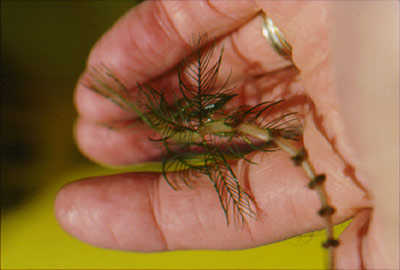
invasion of Eurasian
Water-Milfoil (Myriophyllum
spicatum).
Unlike the bryozoan
(Pectinatella
magnifica,
"Moss Animal") invasion of 1997,
this one is non-native, it's dangerous and, whether we fight it or give
up, it will be expensive. It will affect boating and swimming
activities
at Lake Cochituate for years to come.
Eurasian water-milfoil
is one
nasty weed.
Boats and water
flow can spread it far and wide. Then, in worst-case situations, it
overwhelms existing plants,
takes
over, literally fills shallow water areas as deep as sunlight
penetrates
(in Lake Cochituate, about 12 feet deep), interferes with wildlife, and
degrades water quality. It can grow so thick that fish can't swim there!
Prior to 2002, nearby
lakes
including
Dudley Pond (in
Wayland) and Lake Boone (in Hudson) experienced Eurasian Water-Milfoil
problems. But although Lake Cochituate already had growths of the
non-dangerous
native Northern
Water-Milfoil (Myriophyllum
sibiricum = M. exalbescens),
it had remained blessedly clear of this non-native and invasive aquatic
weed. Unfortunately, in June 2002, Mass. Lakes and Ponds Program
Coordinator
Jim Straub first discovered a heavy infestation of Eurasian
Water-Milfoil
in Pegan Cove - in the southeast corner of South Pond, between U.S.
Army
Natick Labs (SSCOM) and Pegan Cove Park near downtown Natick. Through
the
hot summer it spread further. And, although we're concentrating on this
worst nuisance at the moment, Jim finds two more non-native, invasive
plants
that will also be addressed: Variable Milfoil (Myriophyllum
heterophyllum)
and Curly Pondweed (Potamogeton
crispus).
`
Lake
Cochituate is a chain of ponds, the main ones being
South, Middle and North. South Pond is the only one in which
water-skiing
is permitted, and one of its two ski-boat slalom courses is in Pegan
Cove,
which also is an attractive area for bass clubs, other fishermen,
canoes
and kayaks. The very active boating in that shallow (and nutrient-rich)
section of South Pond is likely to have brought the milfoil there, and
continuing intensive boating there shreds the milfoil into 2-3"
floating
fragments that move with the water or on boats. Boats that repeatedly
carry
fragments to a different shoreline spot increase the risk at that area,
too. Jim immediately proposed to quarantine Pegan Cove to control these
risks. But as of late August that had not happened; no nets had been
placed,
and only initial steps toward weed removal from boats and trailers had
begun. Fragments were floating away, and Eurasian water-milfoil was
showing
up in increasing amounts beyond Pegan Cove.
By late August, Jim
Straub said
the Pegan
Cove infestation
has spread too far to stop it in Pegan Cove. He says that our urgent
need
is to quarantine the entire South Pond, by hanging a double layer of
mesh
netting three feet into the water at the Route 9 boat tunnel, and then
to attempt early matting and/or manual removal of the lesser amounts of
milfoil that are establishing in a few coves on Middle Pond and perhaps
(none identified yet) on North Pond. Middle Pond is to be quarantined
from
North Pond, as well, and other nets will monitor stream inputs and the
outfall at Cochituate Dam.
Jim says he can handle
the
technical part,
but it is up
to others to handle the politics. Although he has the authority to
place
the quarantine nets, the cooperation of the boaters, abutters and town
boards will be necessary. The Cochituate State Park Advisory Committee
supports this immediate effort and the development of a long-range
management
plan by January 2003. We anticipate equally strong support from our
lake's
regular users. Massachusetts Commissioner of Environmental Management
Peter
Webber has already said, "Do what it takes!" to stop this spreading
infestation.
Mass. Forests & Parks Regional Supervisor Don Stoddard has made
it
clear that while recreational activities are very desirable here,
protecting
the resource will definitely come first. I have set up this personal
Web
page to help inform legislators, reporters, town and state agency
officials
and the lake user community. See the contact list below; we all solicit
your ideas and support.
Expected steps,
September 2002:
 |
Quarantine each pond with
netting, to
isolate the sections
of Lake Cochituate before more milfoil can be shredded and transported
throughout the lake or into other lakes and ponds. Other nets may be
placed
at additional important locations. |
|
Recreational boating is
continuing in Pegan
Cove and
other heavily-infested areas. |
|
Improve mandatory
weed-removal from boats
and trailers
at launching ramp. |
|
Ensure that all boats
launching and leaving
Lake Cochituate
(not just at the State boat ramp) are clear of milfoil. |
|
Contract with an
environmental consulting
firm to develop
a management plan for 2003. |
Some 2003
options under
consideration (ones
already
discussed with DEM):
|
Isolate South Pond hot
spots, by containing
the floating
bits of milfoil with additional mesh barriers that reach three feet
down
into the water. Or, alternatively, allow general spread within South
Pond. |
|
Carefully hand-pick
lightly infested coves
elsewhere
in Lake Cochituate. We'll need volunteers and organizers; this method
has
been used effectively at Dudley Pond and elsewhere. |
|
Use mechanized harvester
or suction dredge,
etc., to
physically remove the weeds. Can create more fragments to spread.
Expensive
and long-term; more like mowing a lawn than removing it. |
|
Milfoil weevils, aquatic
insects, have been
introduce
elsewhere with mixed success. |
|
Use a selective poison
such as Sonar (tm).
But South
Pond is a major source of Natick's drinking water supply. |
|
Cover dense areas with
black mats, to
deprive plants
of sunlight. |
|
Install a coffer dam to
isolate Pegan Cove,
then draw
it down this winter to freeze and kill its milfoil - and possibly
remove
its nutrient-rich sediment, as well. This method has been very
successful
where it can be done. We are aided by a new USGS study and map, showing
both the bottom surface and the depth of bottom sedimentation. On that
map, you can see where a coffer dam might be placed, all at less than
10-foot
depth and free of bottom sediment. An earlier filter dam was placed
there
for opposite reasons, back in the 1860s - when Boston drank so much
Cochituate
Reservoir water that Pegan Cove became a stinking mud flat near
downtown
Natick, until the filter dam kept it covered with water! |
|
Draw down the entire chain
of lakes by
opening Cochituate
Dam and exposing shallow areas throughout. The main dam, and depth
between
ponds, would limit this draw-down to much less than full depth in Pegan
Cove unless the drawdown were increased with pumping or siphoning.
It
might be combined with a smaller coffer dam at the mouth of Pegan Cove. |
Either draw-down option,
or both
in
combination, might
be a best way to avoid losing the South Pond of Lake Cochituate - and
this
may be the final season in which we have that option. Too expensive?
What
would DEM pay to acquire a South Pond, if it were lucky enough to find
one for sale? Too experimental? Both were done at Lake Cochituate about
four years earlier, while repairing Cochituate Dam.
How quickly can DEM
evaluate
these options?
Would one
or a combination significantly protect the rest of Lake Cochituate?
Would
it permit the rest of South Pond to be cleared of milfoil, or would
South
Pond have to remain quarantined? How should the early planning be
modified
to address Variable Milfoil and Curly Pondweed? Was Summer 2002's
continued
boating in the most sensitive areas acceptable within Precautionary
Principle guidelines, or should
DEM respond differently to furthur
infestations? Various groups will be addressing these questions and
more.
How boaters and
lake
abutters can help:
How can you
help protect Lake Cochituate
from this new but massive Eurasian Water-Milfoil infestation at Pegan
Cove
in South Pond, and from the already-evident spreading of this growth to
other coves on Lake Cochituate? Understand the problem (read this, and
perhaps the resource links below), and don't gamble with our wonderful
lakes. Volunteer to help, but don't
pull the weeds from the
lake without proper supervision; the easily-broken-off fragments can be
far more destructive than any plants you can remove.
If you're a
boater, don't go near known infested areas,
obey the quarantine rules (which may mean limiting your boating to one
of Lake Cochituate's ponds), and clean all weed fragments off of your
boat
and trailer immediately after leaving any body of water. It's a new
game
and an unpleasant one, so don't let your guard down.
Bottom line:
This is an
emergency. Decisive action this season may
be our last chance. The strong interest in Lake Cochituate as a
recreational
resource, and an unusual separation of areas due to its physiology,
provide
unusual opportunities for major action.
Resources
Links
(Milfoil):
Invasive
Aquatic Species (Massachusetts
DEM Lakes and Ponds Program)
Invasive
Plants Banned in MA (2006)
Do
I Have Non-Native Plants In My Lake?
(taxonomy;
Massachusetts DEM Lakes
and Ponds Program)
Eurasian
Water-Milfoil (University of
Florida)
Eurasian
Watermilfoil, a problem in
Vermont
Eurasian
Watermilfoil (University of
Minnesota)
Eurasian
Watermilfoil Management Program
(Minnesota Dept. of Natural Resources)
Eurasian
Watermilfoil (U.S. Invasive
Species profile)
Eurasian
Watermilfoil Bibliography/abstracts
(Sea Grant Nonindigenous Species
Site,
USDA;
invasivespecies.gov)
Bibliography
for Biocontrol of Eurasian Watermilfoil
(University of Minnesota,
Department
of Fisheries & Wildlife)
The
Center for Aquatic and Invasive Plants
(University of Florida)
Invasive
Species (general, animals and
plants; U.S. Federal gateway site)
Brochure: Invasive
Aquatic Plants: What Every Plant Enthusiast Needs To Know
(425KB
.pdf file)
What
Can I Do? (from above brochure,
University of Illinois)
Protect
Your Waters and Stop Aquatic Hitchhikers!
(USFWS and USCG)
Lake
Cochituate and Cochituate State Park
(plus, small sketch
map
and
big MassGIS
orthophoto mapping)
Natick
Drinks From Its Lake (SSCOM
CERCLA data, 2001)
Plate: South
Pond bottom sediments (USGS,
2001; 2.7MB .pdf file requires Adobe
Acrobat Reader)
Dudley
Pond webpage (a milfoil
infestation just north of Lake Cochituate)
Links
(Related Herbicides):
Types
of Pesticides (U.S. Environmental Protection Agency)
EnviroTools (Michigan State University)
Aquatic
Herbicide Alert (Toxics Action
Center and Wellesley, Massachusetts, 2002)
Material Safety Data Sheet: Reward
(Diquat Dibromide)
Diquat
Dibromide (Reward) Application Withdrawal(New
York State, 2001)
Final
Risk Assessment
for Diquat Bromide (Reward;
State of Washington, 2002)
Material Safety Data Sheet: Aquathol-K
(Dipotassium Endothall)
Material Safety Data Sheet: Sonar
(Fluridone)
Sonar (Fluridone)
, "European
Commission: Not allowed to be used as an
active
ingredient after July 25, 2003"
Updated
Eurasian Water Milfoil Management Plan for Lake George
(2005),
an
apparent rejection of the
Lake
George Sonar Demonstration Project
(2001)
Links (Alternative
Methods):
Eco-Guide
International (using Little River
Pond Mill) in Quebec:
Using Little
River Pond Mill:
Control
of Eurasian Watermilfoil with the usage of wind-powered aerator/mixer
(1999);
Control of
Eurasian Milfoil (Myriophyllum spicatum) using wind-powered water
circulators (2005);
Introducing the Lake
Bio-Activator Process (2005)
Eco-Guide
proposal for Dudley Pond (Wayland, MA):
PowerPoint slides for
August 8th, 2006 talk (6.3MB .ppt file; try
[F5] to display,
[Downarrow] to
step through slides or to step within some slides, [Esc] to exit.)
SolarBee (general):
Short online videos
(introductory advertising)
The Potential
of Solar-Powered Water Circulators to
Help Solve Serious
Water
and Energy Problems in the U.S.
(2006)
SolarBee
(Eurasian water milfoil):
Case
Study for Customer Location NY66 (
in
Lloyd, NY)
SolarBee
Experience in Controlling Submerged Macrophytes (updated
October 2006)
SolarBee
at Lake Cochituate:
PowerPoint slides for March
23rd, 2006 talk (4MB .pdf file)
SolarBee
Experience in Inhibiting Submerged Macrophyte Growth (updated Feb. 2010, see page 7; 2.1MB .pdf file)
Links (Invasive Species):
W2O
slideshow, "Weeds Watch Out!; Stop Invasive Aquatic Plants"
(northern NY State, 2005)
One
Hundred of the World’s Worst Invasive Alien
Species, part of the Global Invasive
Species Database.
Library:
Look up Milfoil
in books on Botany, Pond Life, etc.
Contact
info:
Cochituate State
Park Supervisor, Tim Murphy (508/653-9641 in Natick, Mass.)
Mass. DCR District Manager, John Dwinell (508/788-3552 in Framingham)
Mass. DCR Regional
Supervisor, Susan Hamilton (978/369-3350 in Carlisle, Mass.)
Cochituate State
Park Advisory Committee, Than Bogan (508/650-6976;
e-mail
when not urgent)
Author of this
Web page, Dick Miller (508/653-6136,
9am-9pm; e-mail at page bottom)
Mass. DCR Lakes
and Ponds Office, Jim Straub (617/626-1411 in Boston, Mass.)
Mass. DCR Water
Quality Office, Anne Monnelly (617/626-1395 in Boston, Mass.)
