A PALM-TREE
by German writer/poet Heinrich Heine
(1797-1856)
| A
single fir-tree, lonely, on a northern mountain height, sleeps in a white blanket, draped in snow and ice. His dreams are of a palm-tree, who, far in eastern lands, weeps, all alone and silent, among the burning sands. |
THE RIDDLE OF THE DINOSAUR
by Bert Leston Taylor (1866-1921; Chicago Herald-Tribune, Oct. 24th, 1905)
| Behold
the mighty dinosaur Famous in prehistoric lore, Not only for his power and strength But for his intellectual length. You will observe by these remains The creature had two sets of brains — One in his head (the usual place), The other in his spinal base. Thus he could reason "A priori" As well as "A posteriori." No problem bothered him a bit He made both head and tail of it. So wise was he, so wise and solemn, Each thought filled just a spinal column. If one brain found the pressure strong It passed a few ideas along. If something slipped his forward mind 'Twas rescued by the one behind. And if in error he was caught He had a saving afterthought. As he thought twice before he spoke He had no judgment to revoke. Thus he could think without congestion Upon both sides of every question. Oh, gaze upon this model beast; Defunct ten million years at least. |
By 1880, Stegasaurus was thought to have two brains, with the second, much-larger one in the hip region of its spine. That still-possible theory inspired this lovely 1905 poem.
The rails that run by Honey Creek are eaten
up with rust,
And no one walks the greasy bed hid in
the roses' dust;
But yet at night a slender ghost may
stalk the quiet sky--
And bats will shiver as they see Kate
Shelley going by.
Kate Shelley from a quiet house, Kate
Shelley in the storm...
She took a lantern in her hand to keep
her spirit warm;
The clouds came up and thundered haste
and Honey Creek was foam;
The waters laughed with blackened
breath below Kate Shelley's home.
"O daughter, go you to the door, I hear a
whistle call,
Crying within the valley dark that
shadows over all.
Your father was a section man; you are
the seed he sowed..
So listen, listen in the storm and
guard the iron road."
Her father was a section man; she knew the
mighty wheels
That ground along the bottom land amid
the tempest's heels.
She listened in the howling dark--and
heard a sundered scream,
When ninety tons of steel went down
into the boiling stream.
"My father was a section man--he reared me
for the road.."
She climbed the gashed and sullen grade
while oaken saplings bowed;
She prayed to gods of spade and pick,
she prayed to tie and rail...
The river bridge was like a priest in
rainy vestments pale.
The midnight coaches from the west plunged
in the dripping rain;
West of Moingona ties were sound--east
was a broken train.
(East in the bile of Honey Creek in one
drowned, twisting curl,
Lay ninety tons of twisted steel.)
Between them was a girl.
Under the river bridge was death--black
fathoms frothing down.
Beyond Moingona sang the train on to a
lonely town;
The engineer swayed in his cab, he
could not see ahead;
"Two hours more...I leave the run and
get me home to bed."
Two hours more...The whistle whined shrill
in the driven rain,
Two hours more...(A broken span, a
ghost where there was a train).
Across the river bridge a girl came
creeping on the ties;
The wind wiped out her lantern flame,
but still she had her eyes.

And still she had her Irish soul, and still
she had her heart!
The spikes cut furrows in her skin and
tore her flesh apart,
Two yards beneath, the river's tongue
clove at the shaking span...
A wraith beside her urged her on: "I
was a section man..."
Down in a pocket of the hills Moingona hid
its head--
And men with muscles pillowed down,
slumbering as the dead,
One light shone thinly through the
night under the battled din,
A bleeding hand clutched the door--a
torn shape staggered in.
No song of thanks, no valiant yell: "God!
and the train is saved!"
None but wheels which tightened down
when crimson lanterns waved;
Nothing but brandy held to lips by
someone of the crew...
"I'll ride the cab," she said, "and
show just where the boys went through."
She rode the cab and guided them. (The
anxious whistle bawled.)
She rode in torn and bloody rags the
ties where she had crawled.
And if the station mice were there they
saw the sundered heap,
And watched the rescue party toil
before Kate went to sleep.
And nine and forty years are gone; the
trains no longer come
Along the crest of Honey Creek before
Kate Shelley's home.
Oh, there were songs for other years
when all the road was hers--
And there were men to bless her name,
and gold to fill her purse.
Be sure you take a lantern flame to keep your spirit warm,
For there will be a phantom train, and foggy whistle cries--
And in the lightning flare you'll see Kate Shelley on the ties.
This story is true; Kate Shelley was "The Iowa Heroine" who crawled across the Des Moines River Bridge on July 6th, 1881 to save a Chicago and North Western passenger train. But she was nearly forgotten when a young reporter, not yet known as one of America's great authors, wrote this tribute in 1930. This poem does not appear in MacKinlay Kantor's poetry collection, "Turkey In The Straw", and it isn't even listed by the U.S. Library of Congress. I am indebted to Charles Irwin of the Boone County Historical Society in Boone, Iowa for providing an old, typewritten copy, and am pleased to share it with you.
You can read more about Kate Shelley at:Boone County Historical Society
Folklore Tribute to Kate Shelley
Wikipedia Talk: Kate_Shelley
Here is an earlier poem, "Kate
Shelly", by Eugene J. Hall:
Kate Shelly poem
"Kate Shelley and the Midnight Express : American folk legend", by Wesley Porter (1979)
"Kate Shelley and the Midnight Express", by Margaret K. Wetterer (1990)
And a videorecording:
"Kate Shelley and the Midnight Express" (2004)
TWENTY YEARS AGO
by Thomas Gold, Jr. (1939)
- I've wandered by the village, Tom, I've sat beneath the tree
- Upon the school-house playing ground, that sheltered you and me;
- But none were there to greet me, Tom, and few were left to know
- Who played with us upon the green, some twenty years ago.
- The grass is just as green, dear Tom, barefooted boys at play
- Were sporting just as we did then, with spirits just as gay.
- The "master" sleeps upon the hill, which, coated o'er with snow,
- Afforded us a sliding place, some twenty years ago.
- The old shool-house is altered some; the benches are replaced
- By new ones, very like the same our pen-knives had defaced.
- But the same old bricks are in the wall, the bell swings to and fro,
- Its music's just the same, dear Tom, as twenty years ago.
- The boys were playing some old game, beneath the same old tree;
- I do forget the name just now--you've played it oft with me
- On that same spot; 'twas played with knives by throwing so and so.
- The loser had a task to do then--twenty years ago.
- The river's running just as still, the willows by its side
- Are larger than they were, dear Tom, the stream appears less wide,
- But the grape vine swing is ruined now, where once we played the beau
- And swung our sweethearts--"pretty girls"--full twenty years ago.
- The spring that bubbled 'neath the hill, close by the spreading beech,
- Is very low--'t was once so high, that we could almost reach,
- And kneeling down to get a drink, dear Tom, I started so,
- To see how much that I am changed since twenty years ago.
- Near by the spring upon an elm, you know I cut your name,
- Your sweetheart's just below it, Tom, and you did mine the same.
- Some heartless wretch had peeled the bark, 'twas dying sure but slow,
- Just as that one whose name you cut died twenty years ago.
- My lids have long been dry, dear Tom, but tears came to my eyes,
- I thought of her I loved so well--those early broken ties.
- I visited the old churchyard and took some flowers to strew
- Upon the graves of those we loved some twenty years ago.
- Some now are in the churchyard laid--some sleep beneath the sea,
- But few are left of our old class excepting you and me;
- And when our time has come, dear Tom, and we are called to go,
- I hope they'll lay us
where we played some twenty years ago.
Page 65 of that historic book prints the Town Seal of the early (and vastly larger) Village of Whitesborough. It depicts Hugh White in a friendly wrestling contest with an Oneida Chieftain, accepting a favorite sport of his new neighbors. Some 230 years later, unknowing and suspicious fans of Political Correctness want Whitesboro's traditional seal redesigned; they assume Hugh White is strangling his new Indian friend. (Look closely at that 1881 engraving; White's hand is on the shoulder, and most certainly not about the throat, of his friend. Earlier in the book, there is further reference to the unusual trust that Hugh White and the Oneidas shared.) I am reminded that PETA, a modern animal-rights group, actually mounted a campaign to make New York State rename the Catskill Mountains--themselves ignorant of (and later, ignoring) the region's early Dutch-settler word for Creek, which was Kill; hence, Kaater's Kill, now Catskill. In Whitesboro, too, I hope that history-understood will persevere over the temporary enthusiasms of worst-assuming crowds.
BTW, Indian?
Yes; back then, Native
American was in neither group's vocabulary.
And to this day, my Natick
Praying Indian friends agree. History, after
all, is His
Story. Not ours.
FOUR
PROMINENT BASTARDS
by Ogden Nash (1933)
He performed it for the Gridiron Club in 1941.
The banker:
I'm an autocratic figure in these democratic states.
I'm a dandy demonstration of hereditary traits.
As the children of the baker bake the most delicious
breads,
As the sons of Casanova fill the most exclusive
beds,
As the Barrymores, the Roosevelts, and others I
could name
Inherited the talents that perpetuate their fame,
My position in the structure of society I owe
To the qualities my parents bequeathed me long ago.
My pappy was a gentleman and musical to boot.
He used to play piano in a house of ill repute.
The madam was a lady and a credit to her cult.
She enjoyed my pappy's playing, and I was the
result.
So my mammy and my pappy are the ones I have to
thank
That I'm chairman of the board of the National
County Bank.
Chorus:
Oh, our parents forgot to get married.
Oh, our parents forgot to get wed.
Did a wedding bell chime? It was always a time
When our parents were somewhere in bed.
Oh, thanks to our kind, loving parents,
We are kings in the land of the free --
Your banker, your broker, your Washington joker,
Three prominent bastards are we, tralalala,
Three prominent bastards are
we.
The broker:
In a cozy little farmhouse, in a cozy little dell,
A dear, old-fashioned farmer and his daughter used
to dwell.
She was pretty, she was charming, she was tender,
she was mild,
And her sympathies were such that she was frequently
with child.
The year her hospitality attained a record high,
She became the happy mammy of an infant, which was
I.
Whenever she was gloomy, I could always make her
grin
By childishly inquiring who my pappy might have
been.
The hired man was favored by the girls in mammy's
set,
And a traveling man from Scranton was an even-money
bet,
But such were mammy's motives, and such was her
allure,
That even Roger Babson wasn't altogether sure.
Well, I took my mammy's morals, and I took my
pappy's crust,
And I grew to be the founder of a big investment
trust.
Chorus
The senator:
On a lonesome southern chain gang on a dusty
southern road,
My late lamented daddy made his permanent abode.
Now some were there for stealing, but daddy's only
fault
Was an overwhelming weakness for criminal assault.
His philosophy was simple and free from moral tape:
Seduction is for sissies -- a he-man wants his rape.
Daddy's total list of victims was embarrasingly
rich,
And though one of them was mammy, he couldn't tell
me which.
Well, I didn't go to college, but I got me a degree:
I reckon I'm the model of a perfect S.O.B.
I'm a debit to my country, but a credit to my dad:
I'm the most expensive senator the country ever had.
I remember daddy's warning me that rapin' is a
crime,
Unless you rape the voters a million at a time.
Chorus
You and I:
I'm an ordinary figure in these democratic states,
A pathetic demonstration of hereditary traits.
As the children of the cops possess the flattest
kind of feet
And the daughter of a floosy has a wiggle to her
seat,
My position at the bottom of society I owe
To the qualities my parents bequeathed me long ago.
My father was a married man, and what is even more,
He was married to my mother, a fact that I deplore.
I was born in holy wedlock; consequently bye and bye
I was rooked by every bastard with plunder in his
eye.
I invested, I deposited, I voted every fall,
And if I saved a penny, the bastards took it all.
At last I've learned my lesson and I'm on the proper
track:
I'm a self-appointed bastard, and I'm going to get
it back!
Chorus:
Oh, our parents forgot to get married.
Oh, our parents forgot to get wed.
Did a wedding bell chime? It was always a time
When our parents were somewhere in bed.
Oh, thanks to our kind, loving parents,
We are kings in the land of the free --
Your banker, your broker, your Washington joker,
Three prominent bastards are we (and ME!),
Four prominent bastards are
we!
I looked this up at Harvard University. I copied it with a pencil (I was not allowed to photocopy it), and this is the result. I did not have time to copy the tune, but it is not the one Oscar Brand uses. I have never seen it in a collection, either.
-- It was published as a booklet (15 pp.): Four Prominent So and So's: lyrics by Ogden Nash, music by Robert Armbruster, illustrations by Otto Soglow; New York: Simon and Schuster, 1934. The Houghton Library at Harvard has it. In addition to changing the tune, Oscar Brand left out the fourth bastard & stanza, thereby depriving the song of its full malice.
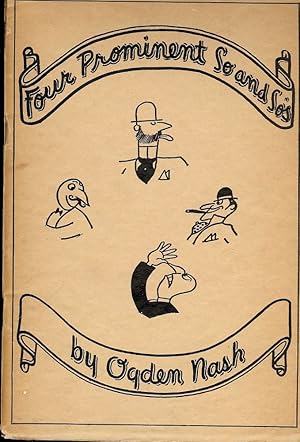 Dick Miller:
It's almost identical to the version that I learned in New York City, from Kelly Beller about 1950. I changed the chorus to "three", and added the "(and ME!)" to the different final chorus, as I learned it and as makes better sense. According to a note to the reader in the 1934 first edition, pirated editions of the Bowdlerized version had previously appeared and Nash was issuing it in its original form. He probably left it out of his 4-part anthology because "bastard" just wasn't socially acceptable then, at least in that context. Even the version he did print was entitled, "Four Prominent So and So's".
On Fifty-second Street
Uncertain and afraid
As the clever hopes expire
Of a low dishonest decade:
Waves of anger and fear
Circulate over the bright
And darkened lands of the earth,
Obsessing our private lives;
The unmentionable odour of death
Offends the September night.
Accurate scholarship can
Unearth the whole offence
From Luther until now
That has driven a culture mad,
Find what occurred at Linz,
What huge imago made
A psychopathic god:
I and the public know
What all schoolchildren learn,
Those to whom evil is done
Do evil in return.
Exiled Thucydides knew
All that a speech can say
About Democracy,
And what dictators do,
The elderly rubbish they talk
To an apathetic grave;
Analysed all in his book,
The enlightenment driven away,
The habit-forming pain,
Mismanagement and grief:
We must suffer them all again.
Into this neutral air
Where blind skyscrapers use
Their full height to proclaim
The strength of Collective Man,
Each language pours its vain
Competitive excuse:
But who can live for long
In an euphoric dream;
Out of the mirror they stare,
Imperialism's face
And the international wrong.
Faces along the bar
Cling to their average day:
The lights must never go out,
The music must always play,
All the conventions conspire
To make this fort assume
The furniture of home;
Lest we should see where we are,
Lost in a haunted wood,
Children afraid of the night
Who have never been happy or good.
The windiest militant trash
Important Persons shout
Is not so crude as our wish:
What mad Nijinsky wrote
About Diaghilev
Is true of the normal heart;
For the error bred in the bone
Of each woman and each man
Craves what it cannot have,
Not universal love
But to be loved alone.
From the conservative dark
Into the ethical life
The dense commuters come,
Repeating their morning vow;
"I will be true to the wife,
I'll concentrate more on my work,"
And helpless governors wake
To resume their compulsory game:
Who can release them now,
Who can reach the deaf,
Who can speak for the dumb?
All I have is a voice
To undo the folded lie,
The romantic lie in the brain
Of the sensual man-in-the-street
And the lie of Authority
Whose buildings grope the sky:
There is no such thing as the State
And no one exists alone;
Hunger allows no choice
To the citizen or the police;
We must love one another or die.
Defenceless under the night
Our world in stupor lies;
Yet, dotted everywhere,
Ironic points of light
Flash out wherever the Just
Exchange their messages:
May I, composed like them
Of Eros and of dust,
Beleaguered by the same
Negation and despair,
Show an affirming flame.
From Another Time,
Poems by W. H. Auden (1940). Auden later disowned this
poem, which he wrote at the outbreak of World War II,
in the same year he moved from England to the USA. The
poem apparently was also inspired by Psychology and Religion
(C. G. Jung, 1938).
April 18th - Protest march:
First, students
stood, and asked to speak
With rulers now
grown old and weak.
They sought a fair
exchange of views,
Honest rulers,
honest news.
Their rulers
shunned them, week by week.
April 22nd - Hunger
strike:
The students stood in Tiananmen
Square.
"Democracy!", they said. "Be fair!"
Soon, a million with them stood
And all were hopeful, all were
good.
But the rulers were not there.
May 20th - Martial law declared:
At last, the rulers gave a sign.
They would maintain their Party
line,
Ignore the people, suppress the
news,
Fight to hold their hard-won views.
To act all-knowing, yet still
benign.
May 20th - Army dispatched:
The people bravely held their
Square.
When tanks and soldiers tried to
marshal there,
Ten thousand unarmed patriots
before them stood
And stopped them, chanting
"Brotherhood!"
The rulers must have torn their
hair.
June 4th-27th - Army attacks
defenseless citizens:
Forty-four days these patriots held
their ground,
But then, less friendly soldiers
came around
And massacred five hundred, or
three thousand. Some say more;
Perhaps we'll never know the awful
score.
The rulers then were nowhere to be
found.
Epilogue:
The rulers, heroes once themselves,
thus fiercely held their sway.
In Tiananmen Square, new heroes
bled their lives away.
Beijing, and soon all China, saw
the truth:
Old heroes now oppressed the
country's youth.
Old heroes once, they lost their
nation's love today.
First published in The Middlesex
News (Framingham, Massachusetts, USA), June
14th, 1989 (page 13A). Copyright 1989 by A.R.Miller.
"Like hell, we can!" said Bill.
Bill looked at me, and he winked his eye,
But we started up the hill.
The day is mild, the sky is blue,
The wind blows light and steady.
We reach the top and walk across
To the cliff. Says he, "We're ready."
Small pines point up from the valley floor,
As we view the ground below.
I look at Bill, Bill looks at me,
And together, we say, "No!"
"It's not that hard," our teacher says,
"So long as you don't say no."
"No way!", says Bill. He starts down the hill,
and I turn to follow him, so.
But I turn and look as, at the ledge,
Our teacher cries, "Let's go!"
He floats off the grass, across the edge,
And slowly drifts below.
"You can fly!", I hear. It's in my ear
The rest of the way back home.
Bill thinks I'm nuts, and perhaps he's right,
But I plan to climb back, alone.
--I wrote this poem upon awakening one morning in April, 2011.
"You can
fly!" "You can fly!" "You can fly!" The
image remained from a dream. It seemed a perfect fit for
the 20th anniversary of the Linux computer operating
system (in August 2011), and for the GNU/Linux
philosophy. Free, open-source software - the opposite of
what's sold in the stores. You can just do it. Expert or
beginner, you can help to spread the word and to make
Linux better.
But the typical first response is resistance. We are
accustomed to follow our beaten paths, and this offer
seems too good to be true. Isn't it just another fake
advertisement, exaggerating the benefit and ignoring the
hassle? Dare we to accept the challenge?
Decades earlier, my wife and I used and taught another
computer language, Forth. Our company's own brand was
MMSFORTH. In those days of speed-limited and
capacity-limited computers, Forth was a "magic wand" for
us and others. But it was different, and too good to be
readily believable. It was a hard sell. I learned to
liken it to that magic wand, saying, "If I were to ask
you to flap your arms and jump off a cliff, you'd rebel.
But suppose that it could
work. How would you ever find out? Forth is that good, and
you won't know unless you try. Here, let me give you a
short demonstration." Some stayed to learn, and did
learn. But most assumed that it couldn't work that well,
and moved on.
I did the same with Esperanto, the simple bridge
language for humans. "Not my cup of tea", was my first
response. But ten years after I had attended that
lecture about Esperanto, I recalled it in a conversation
with my new wife. She checked it out, I followed, and
that brought both of us into one of the many "parallel
universes" that have enriched our lives. As Piet Hein
said, and often it's true, "T.T.T."
This poem is about the
moment of acceptance of a challenge. It can be
any challenge which your mind has been prepared to
reject, but which awakens your curiosity. We all have
these moments of growth. Some are rites of progress for
all. Some are rare. A few of these moments change
society.
Neotony is the preservation of childish traits into
maturity. Curiosity is one of those traits, and lucky is
the human who preserves curiosity into later life.
Parents, friends, and other teachers channel our native
curiosity to the society's goals, and away from danger
both real and perceived. Advertisers try to channel our
curiosity - and fears - into buying their goods.
Politicians and other lawyers... Let's not even go
there.
Once we've been trained to "know" what's right and
wrong, only the most neotenous of us are likely to break
the mold. But that is how we grow. "You can do anything
you put your mind to!" is overstated. But you can make
significant changes for the better, once you put your
mind to it. Can you recognize the right challenge? Do
you dare? Do you
accept the challenge?
Things take time.
--Dick Miller (August
2011)
by Ella Wheeler Wilcox (1850–1919)
("Poems of Problems", pp. 154–55; 1914)
To sin by silence, when we should protest,
Has climbed on protest. Had no voice been raised
Against injustice, ignorance, and lust,
The inquisition yet would serve the law,
And guillotines decide our least disputes.
The few who dare, must speak and speak again
To right the wrongs of many. Speech, thank God,
No vested power in this great day and land
Can gag or throttle. Press and voice may cry
Loud disapproval of existing ills;
May criticise oppression and condemn
The lawlessness of wealth-protecting laws
That let the children and childbearers toil
To purchase ease for idle millionaires.
Therefore I do protest against the boast
Of independence in this mighty land.
Call no chain strong, which holds one rusted link.
Call no land free, that holds one fettered slave.
Until the manacled slim wrists of babes
Are loosed to toss in childish sport and glee,
Until the mother bears no burden, save
The precious one beneath her heart, until
God’s soil is rescued from the clutch of greed
And given back to labor, let no man
Call this the land of freedom.
Ella Wheeler Wilcox fought for U.S. Women's Suffrage. This poem inspired Rachel Carson to write her famous protest letter in 1953, to write "Silent Spring" in 1962, and to inspire, in turn, the creation of Earth Day and of the U.S. Environmental Protection Agency.
Let it be the dream it used to be.
Let it be the pioneer on the plain
Seeking a home where he himself is free.
(America never was America to me.)
Let America be the dream the dreamers dreamed--
Let it be that great strong land of love
Where never kings connive nor tyrants scheme
That any man be crushed by one above.
(It never was America to me.)
O, let my land be a land where Liberty
Is crowned with no false patriotic wreath,
But opportunity is real, and life is free,
Equality is in the air we breathe.
(There's never been equality for me,
Nor freedom in this "homeland of the free.")
Say, who are you that mumbles in the dark?
And who are you that draws your veil across the stars?
I am the poor white, fooled and pushed apart,
I am the Negro bearing slavery's scars.
I am the red man driven from the land,
I am the immigrant clutching the hope I seek--
And finding only the same old stupid plan
Of dog eat dog, of mighty crush the weak.
I am the young man, full of strength and hope,
Tangled in that ancient endless chain
Of profit, power, gain, of grab the land!
Of grab the gold! Of grab the ways of satisfying need!
Of work the men! Of take the pay!
Of owning everything for one's own greed!
I am the farmer, bondsman to the soil.
I am the worker sold to the machine.
I am the Negro, servant to you all.
I am the people, humble, hungry, mean--
Hungry yet today despite the dream.
Beaten yet today--O, Pioneers!
I am the man who never got ahead,
The poorest worker bartered through the years.
Yet I'm the one who dreamt our basic dream
In the Old World while still a serf of kings,
Who dreamt a dream so strong, so brave, so true,
That even yet its mighty daring sings
In every brick and stone, in every furrow turned
That's made America the land it has become.
O, I'm the man who sailed those early seas
In search of what I meant to be my home--
For I'm the one who left dark Ireland's shore,
And Poland's plain, and England's grassy lea,
And torn from Black Africa's strand I came
To build a "homeland of the free."
The free?
Who said the free? Not me?
Surely not me? The millions on relief today?
The millions shot down when we strike?
The millions who have nothing for our pay?
For all the dreams we've dreamed
And all the songs we've sung
And all the hopes we've held
And all the flags we've hung,
The millions who have nothing for our pay--
Except the dream that's almost dead today.
O, let America be America again--
The land that never has been yet--
And yet must be--the land where every man is free.
The land that's mine--the poor man's, Indian's, Negro's, ME--
Who made America,
Whose sweat and blood, whose faith and pain,
Whose hand at the foundry, whose plow in the rain,
Must bring back our mighty dream again.
Sure, call me any ugly name you choose--
The steel of freedom does not stain.
From those who live like leeches on the people's lives,
We must take back our land again,
America!
O, yes,
I say it plain,
America never was America to me,
And yet I swear this oath--
America will be!
Out of the rack and ruin of our gangster death,
The rape and rot of graft, and stealth, and lies,
We, the people, must redeem
The land, the mines, the plants, the rivers.
The mountains and the endless plain--
All, all the stretch of these great green states--
And make America again!
My heart leaps up when I behold
A rainbow in the sky:
So was it when my life began;
So is it now I am a man;
So be it when I shall grow old,
Or let me die!
The Child is father of the Man;
And I could wish my days to be
Bound each to each by natural piety.
THE ART OF MAKING AN OMELETTE
by Peggy Sapphire (Jewish Currents, ca. 2000)
At the moment his Liederkranz cheese reached
consummate ripeness on our kitchen counter,
almost liquid with two weeks’ pungency,
my immigrant father, no stranger to making do,
searched the ice box for omelette ingredients.
Liederkranz was a landsmann bearing accent,
a handshake and tears to his eyes, was
brazen with stink only to those who did not know better.
So…yes…the ice box. There he found a solitary green pepper,
an abandoned onion, two serviceable potatoes
and four fine eggs.
As the Teuton he was, my father diced the potatoes into
one-quarter inch cubes with the same surgery he applied to
his weekly wages, then cut similarly sized squares of
onion and pepper. He sautéed all and began
coaxing the edges of the four beaten eggs
as they bubbled in butter in the cast iron skillet.
Bach or Beethoven or Brahms gave grace to our little feast.
We dined at the table I set, he and I, giant golden omelette halves
for each, the Liederkranz centered on a saucer between us
its tin-foiled paper peeled back like petals.
We slathered it on, I as apprentice learning to smear it
across my slices of rye, to take big bites.
He poured the wine. Red.
Talk began. The politics of war and money, union organizing,
Franco, Jew haters, the KKK and dead friends.
“Now I can tell you why I ran,” he said. “I ran for my life,
my working man’s life, my immigrant
life, my learning English life, my ‘brother can you spare a dime’ life,
my loving Paul Robeson life, my Free The Rosenbergs life.
Now I can tell you how I sang the anthems of
Pete Seeger, The Weavers and Josh White.”
“Is that why we moved, each time without warning, in the dawning hours,
headlights on the two-laner North, our car loaded like a truck bed?
Is that why I was taught the sleight of sliding The Daily Worker inside
The Herald Tribune, sent so lonely to do that chore each morning?
Is that why you left us, finally, when the sub-committee found
our front door and pounded day and night?
Is that why you told me trust no one tell no one
we’re like no one no one will understand?”
Holy WQXR News On The Hour silenced us with its signal.
Five minutes of reverence for world affairs, the world of the
Red Menace, Blacklists, White Supremacy, Coloreds
at the back of the bus.
A world in which my father found no safe way home
from the old country to the new, no way back to the
grandfather I would never meet,
whose lessons of Flight and Survival,
of Auschwitz and smoke stacks
were passed along as legacy,
with the art of making an omelette.